The Lost Gold of Geronimo
According to legend, three extraordinarily rich lost mines of gold are said to exist in the Guadalupe Mountains of New Mexico. For centuries, the Apaches were known to obtain gold from a secret deposit there—one that Geronimo himself declared to be the richest in the western world. In the 1880s, prospector Ben Sublett reportedly located a mine in the same range containing gold of a purity unmatched anywhere in the greater Rocky Mountain region, a site that later became known as the Lost Sublett Mine. Long before either account, however, Spanish records described a regional mine so productive that it defied belief.
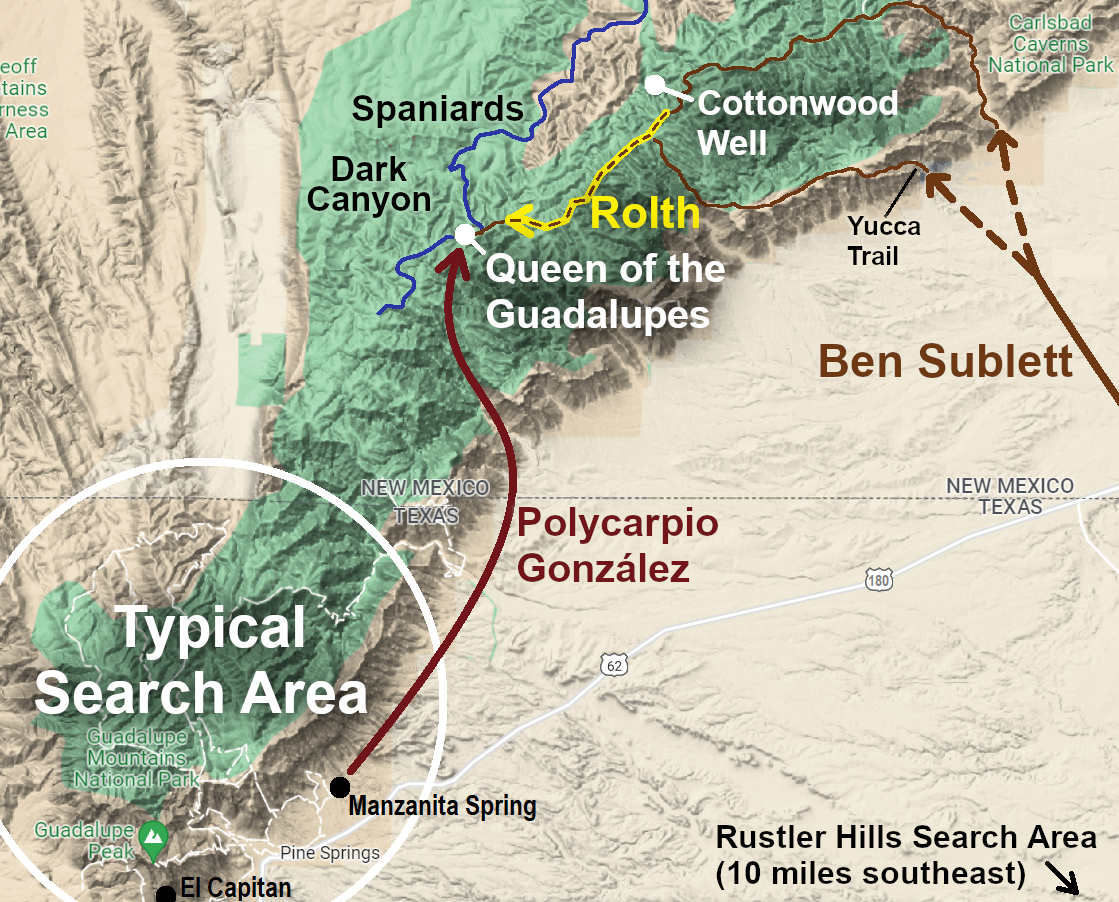
Though these stories are sometimes treated as separate legends, their similarities are too precise to dismiss as coincidence. Each describes a remote gold deposit hidden deep within the Guadalupes. Each speaks of nuggets lying openly on the floor of a crater-like formation reached only after descending fifty feet into the earth. Each involves a shaft or cave descending even further, and each story ends with the mine being deliberately concealed.
The oldest account belongs to the Spanish. In the 1600s, conquistadors reportedly established a large mining operation in the Guadalupes after hearing stories of Indians gathering pure gold from the surface. According to records, the Spaniards worked the mine for sixteen years and extracted fifty-nine tons of gold—more than any other mine of that century. But their success was short-lived. Natives forced to work the mine revolted and destroyed the operation during the Great Pueblo Revolt of 1680. The deposit became known in later writings as the Lost San Antone Mine.
For two centuries afterward, the mine faded into legend. Then, in the 1880s, stories began circulating about a wandering prospector named Ben Sublett. He shocked frontier towns by producing unusually pure gold nuggets supposedly recovered from a hidden mine in the Guadalupe Mountains. He guarded the location obsessively and repeatedly vanished into the wilderness alone. Soon, saloons and frontier towns across West Texas buzzed with rumors of Sublett’s secret source of gold.
Around the same time, another prospector entered the story—a man known as Frenchy. According to accounts later popularized by famed folklorist J. Frank Dobie, Frenchy secretly followed two Mexican miners from Ysleta into the Guadalupes. There he reportedly discovered a crater-shaped mine with rich gold quartz and a deep vertical pit descending into darkness. Frenchy headed back to town, stocked up on supplies and rope, and returned to the mountains determined to explore deeper into the mine. He was never seen again.
Two years later, as the war between the Apaches and the U.S. military intensified, the legends took an unexpected turn. In 1886, according to accounts, the Apaches buried the site beneath massive quantities of earth and rock to keep it from falling into outside hands. After that, reports of Guadalupe gold suddenly ceased.
Polycarpio González, a Mexican raised by the Apaches, reportedly led the effort to conceal the mine under Geronimo’s orders. Forty years later, González—old, sick, and destitute—received treatment from a San Antonio chiropractor named Dr. Black. Grateful for the doctor’s kindness, González led him into the Guadalupe Mountains and revealed the location of the buried mine. Standing atop a mountain marked by unusual heat-forged red and black rocks, González pointed to the ground and declared, “Gold! Fifty feet down!”
Not long afterward, Dr. Black became acquainted with my great-grandfather, Joel Weldy, a rugged mountain wanderer who knew the Guadalupes intimately. Joel spent the next two years working the site alongside the chiropractor. Despite the strange geology and growing clues, Joel still questioned whether this could truly be the legendary lost gold mine of the Guadalupes.
At the same time, Joel had become close friends with Rolth Sublett, Ben Sublett’s son. As a child, Rolth had once accompanied his father to the mine and even picked up gold nuggets there himself. But as an adult, he could never relocate it. For decades, Rolth searched the Guadalupes trying to rediscover the place that had haunted him since childhood. Joel often joined him on these expeditions, though he secretly kept the mysterious hilltop with the distinctive heat-forged rocks hidden from Rolth while trying to determine whether the stories matched.
Then one day, Joel encouraged Rolth to venture just a little farther along his typical search path than he normally did. Immediately, Rolth recognized the terrain. Excited, he hurried forward, insisting they had finally reached the correct location. When they arrived at the site Joel had been excavating, Rolth declared that this was the very spot where his father had once lowered him by rope into the mine to gather gold nuggets. After nearly sixty years of searching, Ben Sublett’s son had confirmed the location of the legendary Lost Sublett Mine.
What began as a small dig soon evolved into a four-generation excavation effort carried on by my family for a full century. Over time, the Weldys quietly excavated a massive crater-like feature, exposed deep vertical pits, uncovered old mining artifacts, and unearthed a human skeleton buried beneath eighty feet of debris. Family members came to believe the remains belonged to Frenchy himself, the ill-fated prospector who vanished after setting out to descend into the mine in the 1880s.
As the excavation continued, additional clues emerged. The structure of the site, its unusual geological features, and the testimony of those connected to the mine all converged, making it clear that all three legendary Guadalupe mines are one and the same, and their location is no longer in doubt.
W.C. Jameson, America’s leading treasure author, had already connected these three mines in his writings long before the Weldys revealed the physical evidence tying them together. After spending more than sixty years searching for the deposit, Jameson visited the Weldy site in 2025 and identified it as the very mine he had pursued for most of his life.
The complete story—along with photographs, historical records, geological evidence, and my family’s firsthand experiences—is documented in my book, The Lost Gold of Geronimo. More information and interactive material can be found at GeronimosGold.com.
Robert Cline wrote this article. His website is here.